
Classical Homeopathy in Depth
A one-year course in homeopathic theory, materia medica and repertorization, taught live by Petr Zacharias. Learn which symptoms should decide your prescription.
€960
early-bird fee, enrolment opens on 1 December 2026
- Live course
- Oct 2027 to Sep 2028
- Format
- 10 live weekends
- Language
- Taught in English
- Afterwards
- 1 year of eLearning
Why this remedy?And why these symptoms?
You study a case and several remedies seem to fit.You recognise each of them, but which symptoms should decide your prescription?In this course, we work through exactly this, step by step.
- Homeopathic theory
Understand the reasons behind your decisions
Why one symptom weighs more than another, how to evaluate a remedy reaction and when to wait.
- Materia medica
See what makes each remedy unique
The connections between symptoms that form a remedy’s pattern, and what tells similar remedies apart.
- Repertorization
Find the rubrics that fit your case
How to turn what the patient says into a reliable rubric, even when no rubric fits exactly.
Who is this homeopathy course for?
Graduates of homeopathic schools
who do not yet feel confident when they prescribe in practice.
Practising homeopaths
who want to understand the reasons behind a prescription, not only the rules.
Students of classical homeopathy
who want to go through the whole theory step by step, with materia medica and repertorization.
Looking for live patient cases? I teach those separately in my International Clinical Training
What will we study during the year?
We begin with the foundations and move to case-taking, follow-ups, the second prescription, potency selection and acute cases. Alongside, I teach materia medica and repertorization.
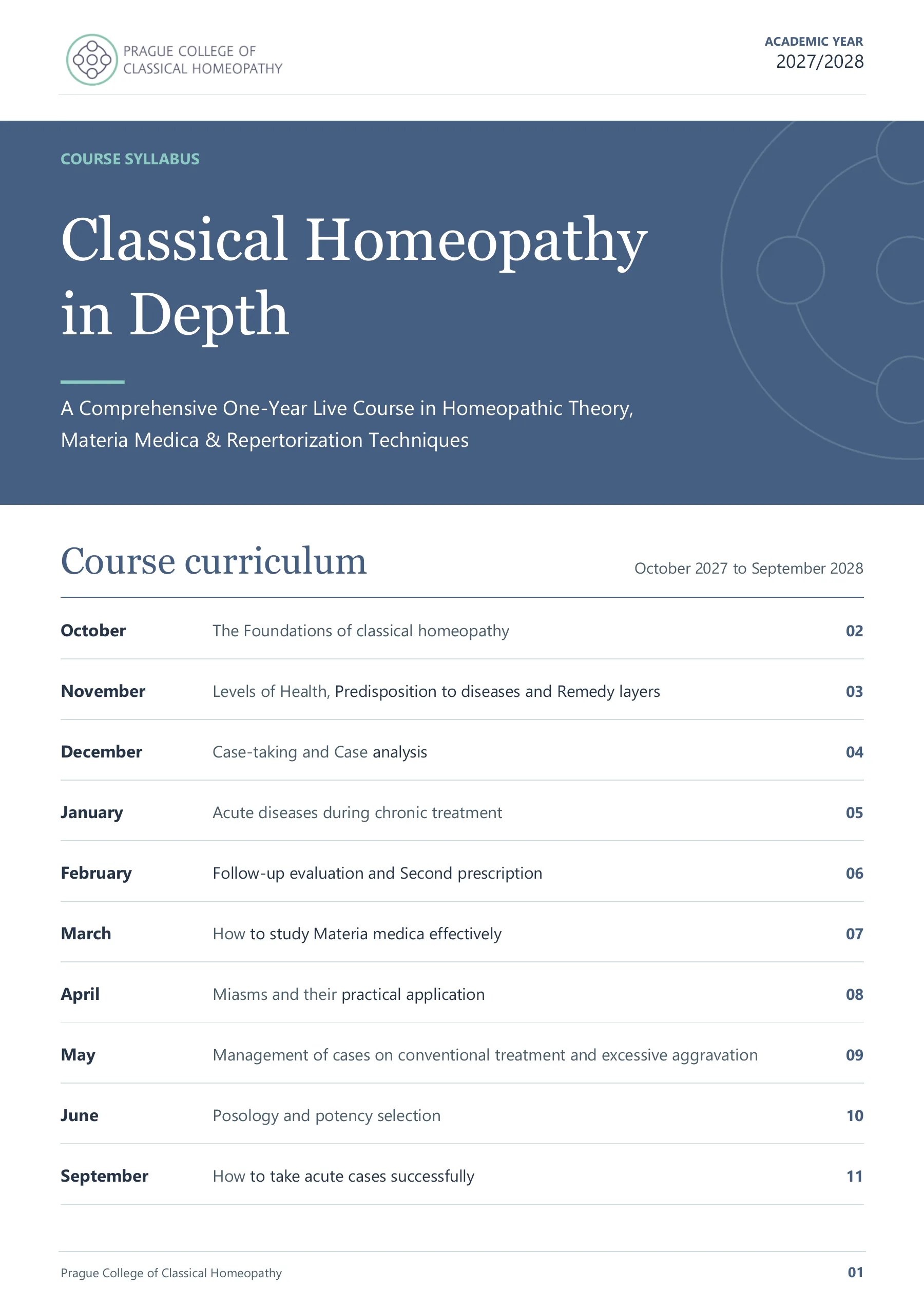 Download the full curriculumPDF, 11 pages
We will begin with the principles we will keep returning to throughout the year: the meaning of symptoms, their hierarchy and the patterns they form.
- Why some symptoms carry more weight; keynotes and SRP symptoms.
- How a remedy picture is formed and how different types of aggravation are described.
- How the repertory is organised, and the differences between Kent, Bönninghausen and Synthesis.
Materia medica: Arsenicum album, Phosphorus, Kali carbonicum, Calcarea carbonica, Calcarea phosphorica, Agaricus muscarius, Cocculus indicus, Arum triphyllum, Digitalis, Cactus grandiflorus, Spigelia
I will explain the Levels of Health model of Prof. George Vithoulkas and the meaning of predisposition, remedy layers and the constitutional remedy.
- The twelve Levels of Health and the mental, emotional and physical planes.
- Layers of predisposition and remedies, and the direction of changes across these planes.
- How to select reliable elimination rubrics and check the result against materia medica.
Materia medica: Aurum metallicum, Carcinosinum, Pulsatilla, Silicea, Ignatia, Sepia, Natrum muriaticum, China officinalis, Ferrum metallicum, Iodum, Kali bichromicum, Lac caninum, Ledum palustre
What information do you need from a patient? How do you decide what is uppermost in the case? We will go through the interview and the reasoning behind the analysis.
- The three stages of case-taking and the interview, step by step.
- Five ways of looking at a case and how to identify uppermost symptoms.
- How and when to combine or cross rubrics.
Materia medica: Causticum, Staphysagria, Lycopodium, Nux vomica, Sulphur, Chelidonium majus, Lilium tigrinum, Lobelia inflata, Mezereum, Petroleum, Calcarea sulphurica
An acute illness appears after a prescription. How do you interpret it? We will examine this question in relation to the Levels of Health and the course of the acute illness.
- The timing, duration and type of an acute episode during chronic treatment.
- How these observations enter the evaluation of the remedy reaction.
- Balanced repertorization and choosing a rubric when none fits the symptom exactly.
Materia medica: Medorrhinum, Lachesis, Argentum nitricum, Rhus toxicodendron, Aconitum, Belladonna, Glonoinum, Eupatorium perfoliatum, Camphora, Lyssinum, Cannabis indica
The follow-up often raises more questions than the first consultation. We will study the different reactions and discuss when to wait and when to consider another prescription.
- Twenty-two observations of remedy reactions and their interpretation.
- The second prescription, complementary and inimical remedies, and six rules for long-term management.
- How to repertorize cases with few symptoms and balance large and small rubrics.
Materia medica: Hepar sulphur, Nitricum acidum, Thuja, Natrum sulphuricum, Natrum carbonicum, Conium maculatum, Carbo animalis, Carbo vegetabilis, Caladium seguinum, Baptisia tinctoria, Borax
What does it actually mean to know a remedy? I will show you how I approach the study of materia medica and what to look for in the sources you read.
- How to identify and extract a remedy’s keynotes.
- Different types of materia medica and where to find reliable information.
- A step-by-step study method, including how the repertory can help.
Materia medica: Phosphoric acid, Picric acid, Muriatic acid, Baryta carbonica, Graphites, Mercurius solubilis, Opium, Helleborus, Spongia tosta, Theridion, Zincum metallicum, Corallium rubrum, Nux moschata, Mercurius corrosivus
We will examine what the term miasm means, the features of the main miasms, and when this information is relevant to the analysis of a case.
- Psora, sycosis, the tubercular and syphilitic miasms.
- Miasms, predisposition and the miasmatic classification of remedies.
- Practical application, common repertorization errors and ways to simplify your work.
Materia medica: Psorinum, Tuberculinum bov., Syphilinum, Hyoscyamus, Stramonium, Tarentula, Capsicum annuum, Anacardium, Bovista, Bromium, Anthracinum
We will discuss the assessment of patients taking conventional medication, the risks of withdrawal, and the interpretation of excessive aggravation.
- Monitoring symptoms and medical findings in cases involving conventional treatment.
- Principles of potency and dosing in these situations.
- Five common reasons for excessive aggravation and how each situation is approached.
Materia medica: Bryonia alba, Gelsemium, Stannum, Chamomilla, Cina, Magnesia muriatica, Magnesia carbonica, Asarum europaeum, Amylenum nitrosum, Antimonium crudum
Which factors should guide potency selection? When do we give a single dose, when do we repeat, and when should repetition stop?
- The reasons for choosing a single dose or repeated doses.
- The main factors that influence the choice of potency.
- A closer look at repertorization software and its different features.
Materia medica: Asarum europaeum, Aesculus, Alumina, Antimonium crudum, Antimonium tartaricum, Cina, Magnesia muriatica, Plumbum, Platinum metallicum, Veratrum album
July and August: summer break
In our final block, we will examine the differences between taking acute and chronic cases and review what we have learned about repertorization and case analysis.
- Four common mistakes in acute case-taking.
- Bönninghausen’s step-by-step approach to obtaining a complete totality.
- The question of an acute or chronic remedy during an acute state, followed by a review of the year.
Ten live weekends, then a year of eLearning
- From 1 December 2026
You enrol
The earlier you enrol, the lower the fee. The course is the same at every price.
- October 2027 to September 2028
Ten live teaching weekends
I teach live in English and answer your questions in Q&A sessions. Between weekends you work on assignments, and we go through the solutions together. No teaching in July and August.
- September 2028
Certificate of attendance
All participants receive an electronic certificate of attendance from the Prague College of Classical Homeopathy.
- The following year
One more year of eLearning
The recordings are edited into a complete eLearning course. You get a further year of access, with unlimited replay and a test at the end of each block that opens the next one.
Petr Zacharias,
Dip. IACH
Founder and principal lecturer of the Prague College of Classical Homeopathy. This course brings the first year of my Czech programme to students worldwide, in English.
- 20+ years of homeopathic practice
- Direct student of Prof. George Vithoulkas
- Internationally recognised homeopath and teacher
- Author of the book Classical Homeopathy in Theory and Practice
- Recipient of the Award for Excellence in Homeopathy

What students say about Petr’s teaching
Now I can find the remedy much easier than 2 years ago and with more confidence, I use the repertory very much less and the materia medica much more than before and I make less mistakes.
Student from Italy
Your lessons have helped me to put into order all this information. Your course is not only about more information on remedies but to me on how to approach a case and how a successful thinking process should go about.
Student from India
Once you start your lecture, I can see how much you care to clear students’ doubts, answer our questions…
Student from Singapore
Study with me from October 2027
10 live teaching weekends, followed by 1 additional year of eLearning access after the live course.
Enrolment opens on 1 December 2026. The earlier you enrol, the lower the fee.
First early bird
€960
1 Dec 2026 to 17 Jan 2027
Opens on 1 December 2026
Second early bird
€1,060
18 Jan to 30 Apr 2027
Standard fee
€1,260
From 1 May 2027
The same complete programme at every price. Deadlines are at 23:59 Prague time.
What the fee includes
- 10 live teaching weekends in English
- Theory, materia medica and repertorization
- Live Q&A and assignments with discussed solutions
- Electronic certificate of attendance
- 1 further year of the edited eLearning course with tests
Enrolment opens on 1 December 2026
The enrolment form will appear here. If you have a question before then, please contact me.
Payment runs through the secure SimpleShop form.
Frequently asked questions
Many of you have already completed your studies and have been practising for years. I have this in mind. We will revisit the foundations in detail and examine the questions that often remain when you try to apply them: distinguishing remedies, choosing rubrics and the reasoning behind follow-up decisions.
[Awaiting Petr’s answer: is the recording available straight away, or only in the eLearning after the live year?]
We will meet on ten weekends between October 2027 and September 2028, with no teaching in July or August. [Awaiting Petr: exact dates, session times with time zone and the platform.]
There will be written case exercises, repertorization homework and live Q&A. Live patient consultations are taught in my International Clinical Training, which continues separately.
I will have the recordings edited during the teaching year. You receive access to the completed eLearning course after the live course has finished. Access lasts for one additional year and includes all edited lessons and tests, with unlimited replay.
At the end of each eLearning block, you take a test on what you have just studied. When you pass it, the next block opens. The purpose is to check that you have understood the material before moving on.
Yes. All participants receive an electronic certificate of attendance issued by the Prague College of Classical Homeopathy.
[Awaiting Petr’s answer.]
[Awaiting the cancellation terms for this course.]
See what we will study together
Ten live weekends with Petr Zacharias from October 2027. Enrolment opens on 1 December 2026 at €960.